Sunday, October 30, 2011

D' Due & Do and Fritter Finder

Hi, all!
D' s Due& Do:
For the last a few weeks, I used D’s Due & do on my planner and I found it not easy to follow initially so I did some changes with it.
At first, I drew a line on the right page using orange color because I am a visual learner, to divide the due column and do column. Based on the design of my planner, I did the "school" thing on the right page and plan the rest on the left page. On the do' s column, I wrote what I would do in terms of courses.

I found it did not work after a week because I left many lines blank and did not write down the enough important for each assignment or exam, not to mention those I should do. So the goal of due and do did not achieve. So I thought that I should combine the strategy of chunking the tasks with Do & Due. After I finished with each tasks, I crossed out the tasks to make myself feel better.

I did feel more organized after the adaptation but I found my planner is messy!!! Since I am a visual and linear learner, I have to make the planner neat and easy to read. Plus, in order to keep on my mind of those tasks I did not finish on time, I divided the original Do's column into two columns, and the left is the things I need to and I write down assignments I need to make up on under the other column. As usual, when I completed with one, I put a check before it.

After the adaptations I made, I felt more confident controlling my time and being more efficient with time.

Fritter Finder:

Even though I had the planner with me every minute, I felt I wasted a lot of time and did not know what to do when I wanted to do some homework or review. I guess that was because I am a linear learner and I need to be more organized. So I listed the courses and what I have to do for everyday:

I did this with the hope that I can be more productive with this table and my planner but after several days experiment, I still did not follow the planner and this table, and I did not catch up with my assigned homework and readings. So when Dr. Blumin said in the class, " if you do what you always do, you will get what you always got", I know I have to change. After thinking about it over again, I felt I need to assign the specific course for my time, which may be helpful for me, so I tried myself with Fritter finder.Basically, I followed the steps as the fritter finder was described before, and I mixed with the table I had before and for each course I have a color to make it visually good for me.
This adapted strategy helps me to utilize time better and keep myself busy all the time!!

Plug-In and 1 Plus 3 Notes for SPA 102 and PSY 205!

Hi everyone! I hope you all had a fun Halloween weekend!

So this past week, I modified my Plug-In Notes for my SPA 102 class. Plug-In Notes is an effective way of studying and reviewing what the professor went over during class after class. I thought these notes would help me keep better organized.

This week, we distinguished the two past tenses, the preterite and imperfect. To make it easier for me to understand the differences between these two tenses, after class I wrote down the regular and irregular conjugations, verb expressions, and when to use them. Since I am a visual learner, I organized these notes in a chart-like form. This helps me in that when I need to differentiate the preterite and imperfect, I can easily flip and refer back to my notes.

Here is a chart of my Plug-In Notes:


I haven't used the Plug-In Notes strategy in my SPA 102 class because I didn't think it would have worked. However, I adapted to it and it actually did
help me keep my notes organized and help me study for future quizzes and tests. I didn't need to write down questions in these notes because it is very hard to anticipate test questions when the test is mostly fill-in the blank.

This week I also decided to try
1 Plus 3 notes again in my PSY 205 class. I thought it would help me summarize the notes I took during lectures and anticipate test questions. Before class, I took notes as usual and then after class I created a chart with key terms, graphic organizers, and test questions that I thought might appear on tests. I used Microsoft OneNote to help me organize these notes. Last time I did not include a graphic organizer, but this time I thought it was vital for me to include some. I ended up making 3 organizers! Since I am a visual learner, the graphic organizers really helped me with remembering certain key words. These notes also helped me anticipate test questions.

Here are my 1 Plus 3 Notes I took for PSY 205:


All in all, both the Plug-In and 1 Plus 3 Notes really helped me keep my notes organized. Plug-In Notes helped me differentiate different terms while 1 Plus 3 Notes helped me anticipate test questions and remember key terms.

Ranking Priorities in...well, all of my classes!

Hi girls! I hope you all had a fun Halloween weekend! I'm so glad it didn't snow like it was supposed to! In honor of the holiday, my blog will be Halloween colors this weekend!

Since we got to choose which strategies to use this week, I decided to use Ranking Priorities in all of my classes, because I have a lot of work from every class, and I know it can help me organize myself so I get my work done without getting stressed.

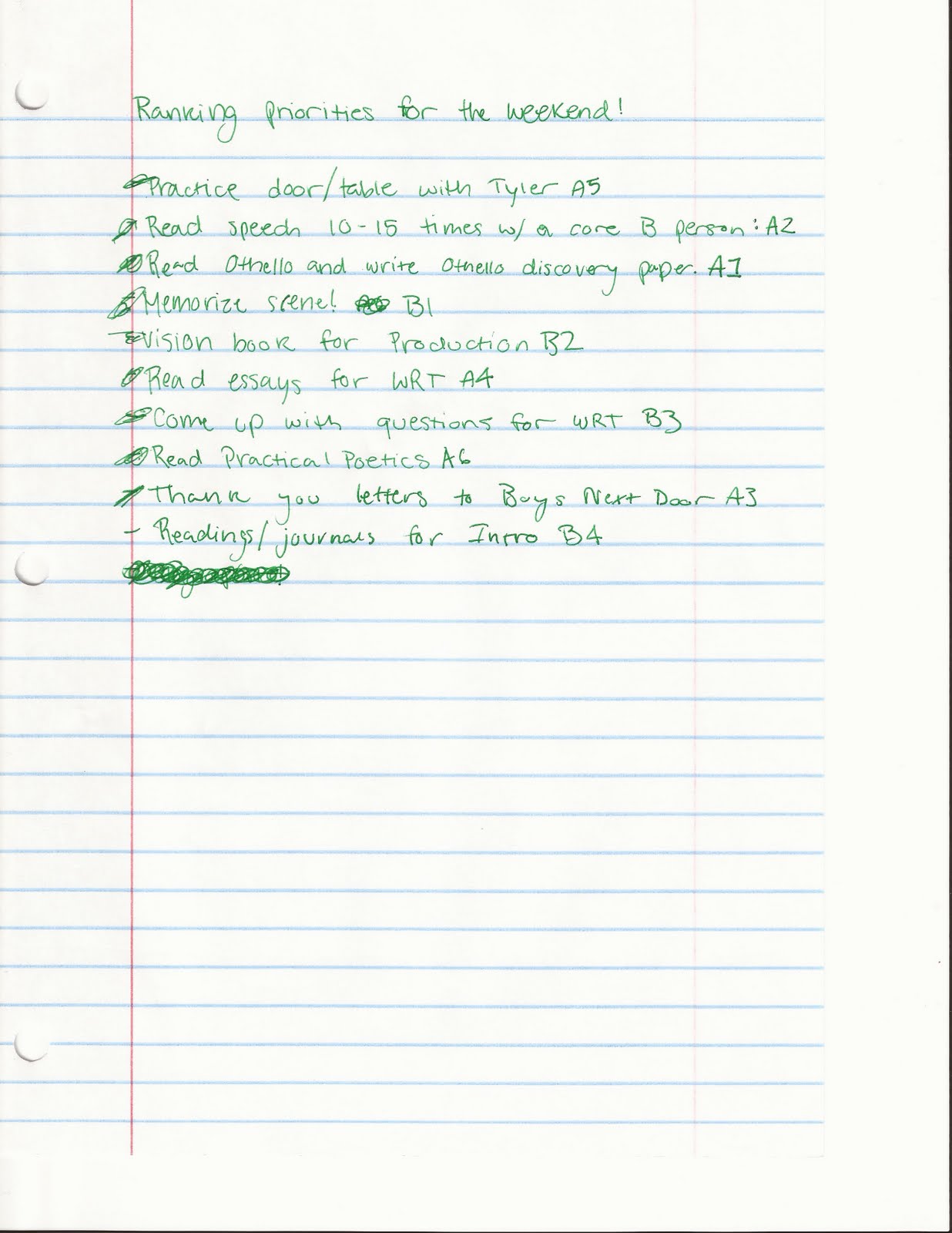
I chose to use this strategy again because it was so helpful the first time we used it for CLS. For my Intro to Theatre class, I have a lot of reading, and a lot of the time it can get really overwhelming. A lot of the time, it gets put off in favor of things that are due in the near future, as opposed to the reading which is due at the end of the semester. I also get a lot of work in my other classes, and though it is not traditional college work (I have to memorize ancient Greek speeches, monologues, and scenes, rehearse with my partner, and practice on my own), it is still a lot. Here is my list of priorities before I organized it into a neat, prioritized list:
Unfortunately, I did not have any optional tasks this weekend, so I had no "C" category, only "A" (Absolutely essential), and "B" (Important). Here is my list after I determined which tasks fit into each catergory:
This strategy not only helps me simply by organizing what I need to do, but it also helps me get what I need to do into my head so I won't forget it. Because I am a Kinesthetic learner, taking notes in class helps me keep focused, and when I use this strategy, writing my tasks down somehow makes them seem more doable for me.

This is a great strategy, and I would definitely recommend it to all of you, and my friends who don't take the class! It's an easy way to manage what you need to do, and when.

See you all tomorrow!

D's Due and Do Organizer & Ranking Priorities Combo!

Hello all! Happy Halloweekend..


Remember the D's Due and Do Organizer? How about Ranking Priorities? These two strategies I have found to be the most useful for me over the course of the semester that I actually began combining them into one! It's been totally effective for me as it keeps me on track with what I need to do and to see what is actually due, all the while I can rank what needsto be done first.

Again, I use my iCalendar to use this powerful strategy combo. First, I fill out what needs to be done on each day of the week. Then I fill in when certain assignments are actually due. This part is almost exactly identical the D's Due and Do Organizer.

Next, I take each do and rank each in terms of top priority, middle priority, or optional; this part is similar to the ranking priorities strategy. You can get these by adding a new calendar on iCalendar:


I then changed the color of each DO. Top priority is red, middle is light blue and optional is green. My DUE's remain the color yellow:


I'm a visual learner so having the colors to highlight what needs to be done at which priority is extremely helpful. In the end I feel so much more organized than if I had just thrown a bunch of to-do's on my calendar. This is my past week on my iCalendar:

Thursday, October 27, 2011

Shuzie' new Due&Do and LINK

Hello, girls! Today is the first day of snowing in Syracuse. I am so excited about it because in my hometown, it is hardly for me to see snow, even in cold winter!

Anyway, because I will fly to Boston tomorrow, so I need to finish this weeks TECH assignment today. During this week, I retried Due& Do for my 4 courses homework assignment schedule and I tried LINK in my own way for my ECN203 class.

Let me talk about Due& Do first.
I know, according to the requirement, I should to retry DUE&DO in just one course. But since this week's assignment is to create our own ways to use learning strategies, and I do need to have a general homework assignment plan for myself, I decided to use Due& Do to arrange my whole weeks stuff, including academic plan and daily life.
Before this week, even I used Do& Due, and I used Fritter Finder, I still felt I could merely guarantee myself to finish assignment right before Due Days. And for Fritter Finder, I always created one on Sunday nights for the following weeks. But the truth is things always change. I could not forecast whether there would be some new things that I didn't know when I created my Fritter Finder but I have to do. In this situation, sometimes I feel like my time is out of my control again and it is really sacks that I read my Fritter Finder every night and always find I didn't finish all the things on the list.
In order to change this situation, I use Do& Due again, but add Ranking Priorities in it. Especially for this week, as what I mentioned at the beginning, I will spend the whole weekend in Boston, so I need to finish all my homework before Saturday. Here is the picture of my this week's new Do& Due.

In Due column, there is no change. But in Do column, I use the Ranking Priorities Strategy. Since I am a visual learner, I use three colors to write down all the things I will do on each day. Red means most important, which also means that I MUST do this today! Blue is important, which represents those stuffs I can finish today or I can just finish some part, don't have to finish whole. Green means less important, which is the signal that if I do not have time, I certainly can put off. Usually, for blue and green stuffs, I always give two days for them. So even I don't have time for one day, I still have the other day to finish it.
This helps me create some time spaces for those things happened suddenly but I need to finish them. For example, on Wednesday, my best friend asked me if I would like to go to the hospital with her because she was very sick at that time. Definitely, I have to accompany with her. So I didn't do the "Reading Mos - Between the World". But on Tuesday, I only had one class on that day, so I finished all the stuffs from red to green, including this reading assignment.
And on Thursday and Friday, since I only have one class for each day, I arrange all my homework for weekend in these two days Do column.
Combining Do& Due and Ranking Priorities together, it not only help me to use my time much more effectively than merely using single strategy, but also help me to finish different kinds of assignments much more earlier than due days easier.

Okay, know I will introduce my LINK usage.
During the class, we were taught to using pictures to memorize terms. But for me, especially I am a new international student, I do not have such a big vocabulary knowledge, so it is a little hard for me to use LINK in that way. Also, for this semester, I do not have any courses that I need to memorize different kinds of awkward terms. The class I need to remember things most is my ECN203 class.
In this week, I learned a lot of Macroeconomy terms. I think the most difficult part for me to memorize is not the names of terms, but the meanings of terms. Every terms has a big word explanation. Remember all the meaning of terms is my headache problem. When I read my professor's powerpoint, I always find it is hard for me to understand and remember those terms. Reading explanations in words is totally makes me feel boring!!
As a result, I draw comics to explain those terms. I have already remember the names of terms, what I need to do is remembering their meanings.
Here is an example of the explanations of Comparing Nominal GDP with Read GDP.
On my professor's powerpoint, the explanation is :
And my comic is :

Nominal GDP is unadjusted GDP. So I draw it in blue, which is a color of quiet and the blue "Price" baby is sleeping. That means the price is unmoved, which is unadjusted.
Real GDP is GDP adjusted for changes in prices. So I draw it in red, which is a color or energetic and active. The red "Price" baby is driving a car and singing. That means the price is alive, which is adjusted.

Another example is Types of Unemployment.
My Professor's explanation is:
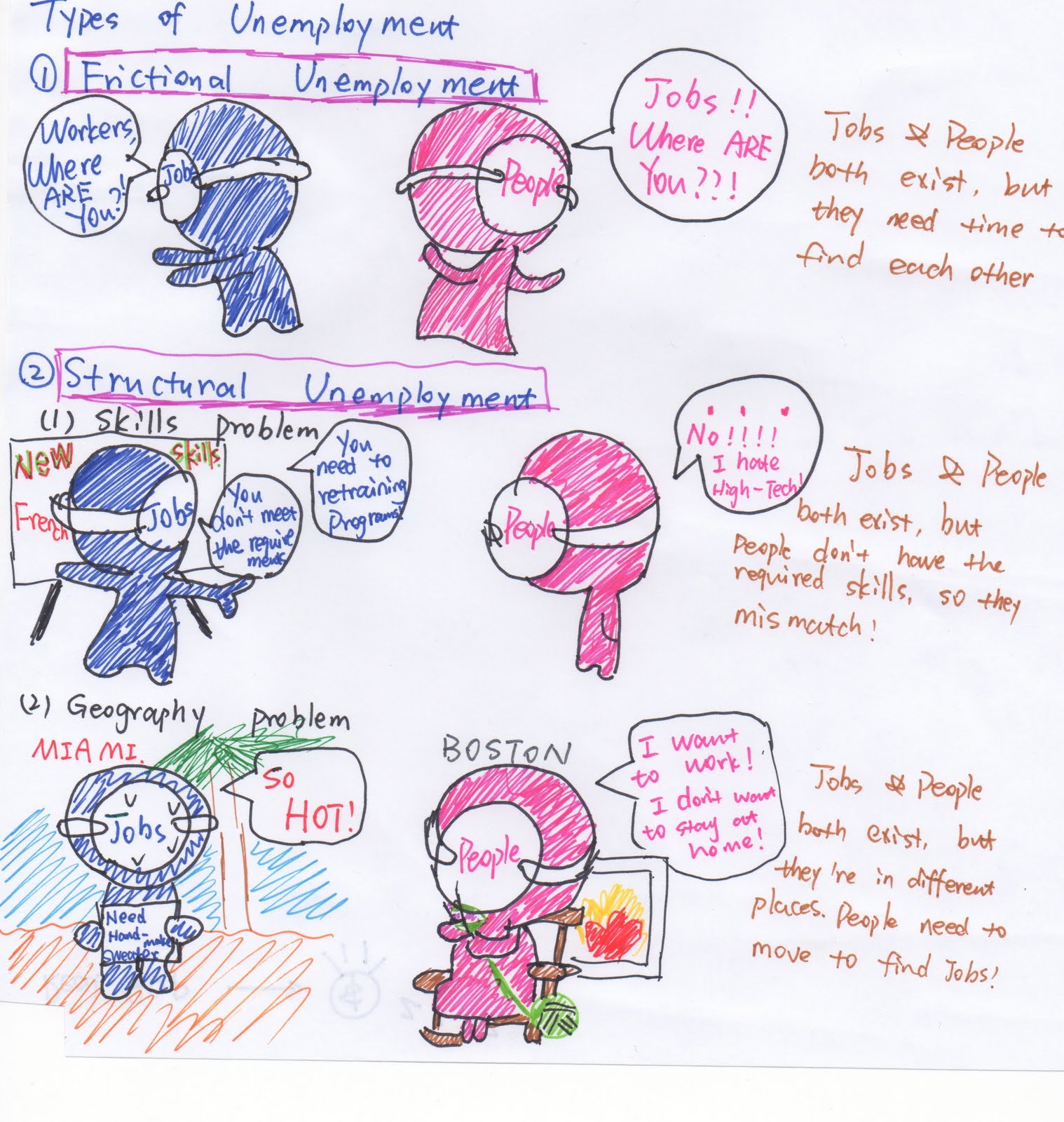
And here is my comic:
In my comic, the little blue child represents JOBS and the pink tiny child represents people who are unemployed and seeking for jobs. I find that the time I drawing comics is also the time I think about these terms. I need to figure out a situation for each term and draw them out. Plus dialogues and explanation. But by using this method, terms are not boring any more and easily to remember their meanings. Visual Learner loves colorful pictures!!!!

Based on reality, making some changes in strategies will be more helpful for me to using those strategies. Hope you love my methods and wish you all had a perfect weekend.

Sunday, October 23, 2011

Charlie Reads SmarT for APH 262 & SPA 301

Hello again! This week I'd like to discuss Charlie Reads SmarT. Do long reading assignments make you cringe? Do you get easily distracted while reading? Do your readings feel so overwhelming that you decide to not do them at all? Well this strategy is absolutely perfect for you!

This strategy makes me almost wish I had a class with long chapter readings. I know how tedious those can be! However, I found that thisstrategy can really be adapted to work with all types of readings. For example, I used this strategy for my Spanish 301 class where we read multiple short stories every week.

First, I took a look at the reading and figured out exactly how long the short story was. Because the story was four pages long, I decided to chunk my reading by reading one page at a time throughout the day. This is what each chunk would look like:


This strategy especially works well with languages because dividing the reading up allows you to digest and understand the reading and the language without getting frustrated.

The next step is to *Summarize*. You can do this in many ways, however since this reading is in a different language, I decided to highlight words I did not know and find out the definition to each. These are my key words; by highlighting them they stand out and I will be able to remember them to use in the future in Spanish:

Lastly, test yourself! I'm a visual and kinesthetic learner, so I wasn't quite sure how this strategy would work for me until I reached this step. For this step I created (kinesthetic) note cards to help me memorize the definitions of the words I highlighted (visual). I also created a couple of questions that would keep me prepared should we have an essay test on this particular story:


*****************

Secondly, I used the same strategy for my Art Photography class. We're required to read many tutorials that explain different techniques in Photoshop and as you can imagine, the readings can feel quite boring and a bit complicated.

So, I took one of my tutorials and chunked it into different sections just as I did with my Spanish reading. This reading was especially easy to chunk because it was already broken up into different sections based on different photoshop tools:

I then tested myself by trying out the technique:


This also works to summarize my work because it shows a side by side comparison of what I did to correct the image.

Overall I believe this strategy was more effective in breaking down my Spanish reading. I was really able to fully understand what was going on in the short story while learning new vocabulary and not getting frustrated. My tutorials for my Art Photography class almost already work in the way Charlie Read Smart does, so I didn't have to adapt much!

Charlie Reads SmarT DRA 115!

Hey girls! I hope you all had a great parent's weekend! I loved getting to see my family - only a month until Thanksgiving!

This week, I chose to use the Charlie Reads SmarT strategy in my DRA 115 class and my Theatre Production class. Being an Acting major, I really don't have any classes besides CLS that use textbooks, so I have chosen two classes for which I have to read plays.

In my Intro to Theatre class this week, we were assigned to read the play Oedipus Rex. Oedipus Rex is an ancient Greek tragedy written centuries ago about Oedipus, the king of Thebes, who, due to a prophecy, accidentally kills his father and marries his mother. It's hard to believe someone could actually accidentally do such a thing, but if you read the play, which I hope you all will because it's brilliant, you'll get it. The play is 18 pages long, so I decided to read 9 pages at a time, just so I knew that my attention wouldn't have time to vanish. I "CHUNKED the task" so that I could read 9 pages, go to dinner, and come back to finish it up. This was a great way to read, as I didn't have an opportunity to get bored, but I did find myself going back to reread sections of what I had read in my previous session to clarify things that were happening in the second 9 pages. Because I am an Aural learner as well as a Kinesthetic one, I got together with two of my friends who are also performance majors to read the play out loud. I read Oedipus's part, which proved to be pretty amusing to all of us :) After I finished the play, I created a list of scenes and SUMMARIZED what happened in them, including which characters were in them. Here is the first page of the final product:
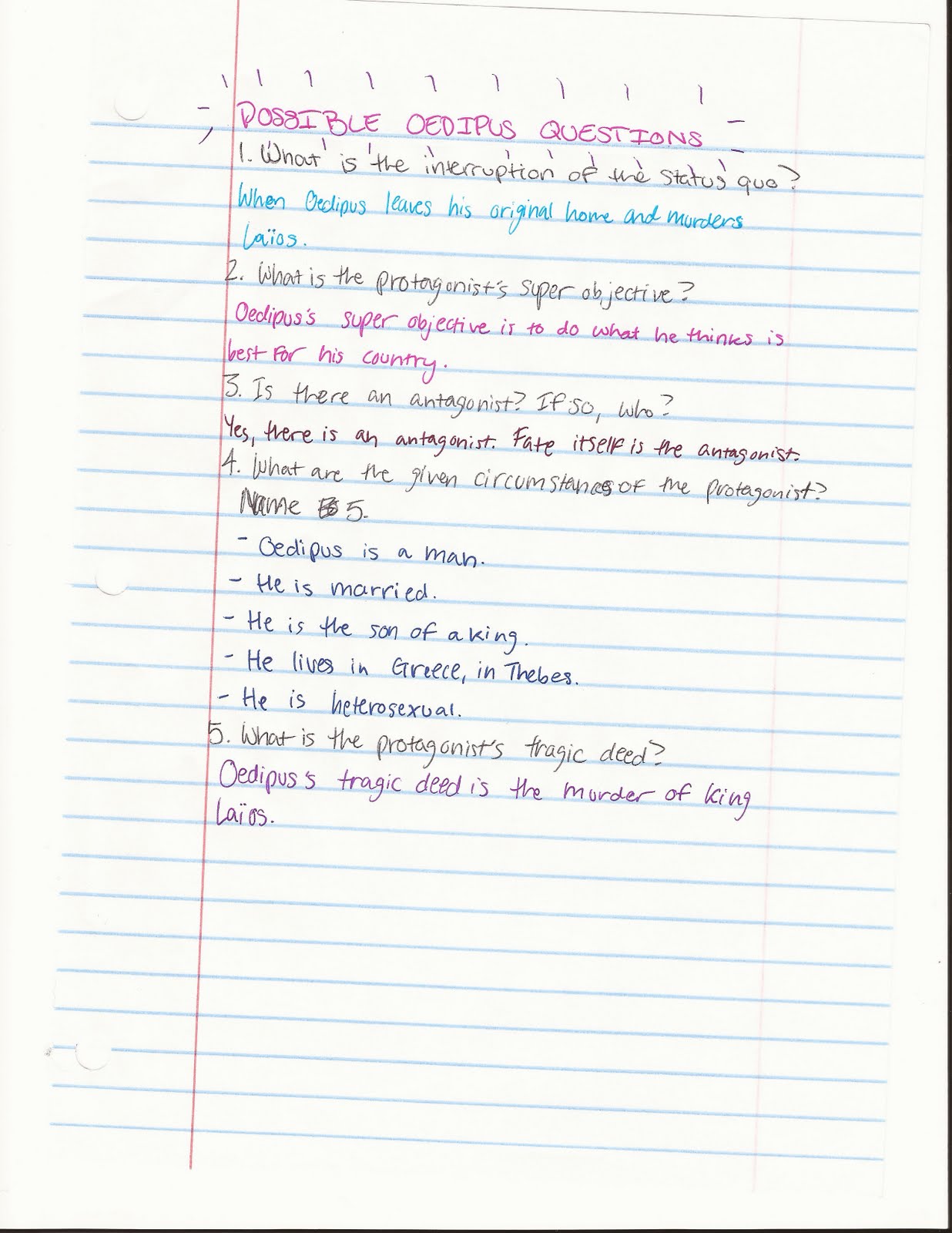
After I made my scene breakdown, to TEST, I came up with a few questions that the professor could possibly ask us. Here they are!

After doing all of this, I feel much more confident in my knowledge of the play than I would have had I simply just read it.

Next, I used the same strategy in my Theatre Production class! In this class, we are making Vision Books, which are scrapbook-like books that directors use to organize their vision for the play they are directing. For my vision book, I chose to create a vision for a production of Tennessee Williams' The Glass Menagerie. It is a gorgeous play, and I am so excited to create my book. But before I was able to create a vision for it, I had to read it. So, naturally, I used the Charlie Read SmarT strategy again, since it worked so well on Oedipus. I used the same adaptions I made to the strategy for Oedipus, and found that it worked just as well with The Glass Menagerie. I CHUNKED the reading, and once I finished, I created another scene breakdown. The play only has four characters, so I didn't include which characters were in which scenes. Here's my scene breakdown:
I just love this play so much! You all should read it! After I did the scene breakdown to SUMMARIZE, I created some questions to TEST myself on the play. Here they are!
All in all, I found this strategy to be very helpful, with the adjustments I made to help it fit my learning styles and classes. I feel prepared for the work I have to do using these plays, and I am eager to use this strategy again for other readings in the future. See you all tomorrow!