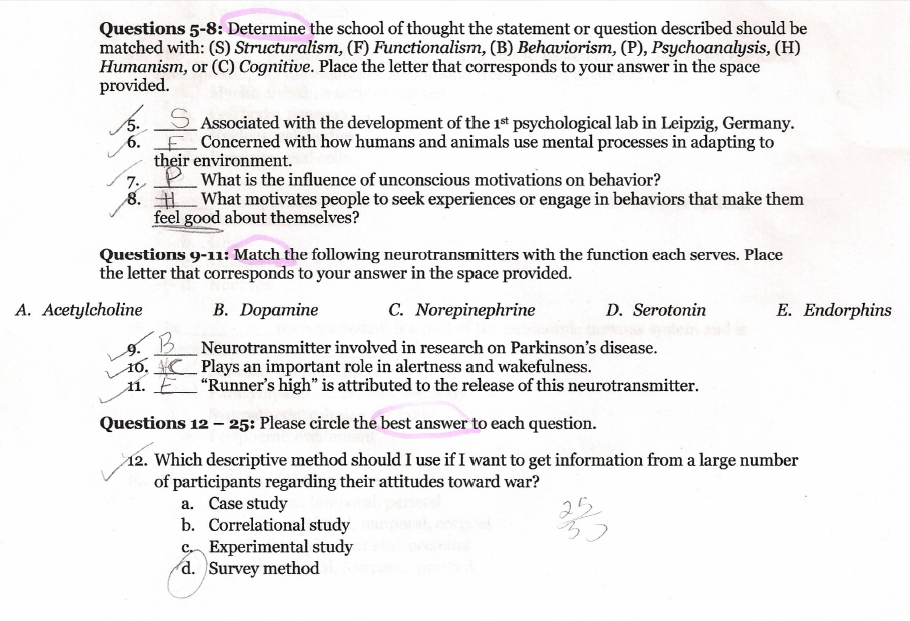
Hey girls! This is the last blog post and I'm going to miss reading everybody's posts. This semester has gone by so fast! It's been tough but great at the same time!
So for my last blog post, I decided to use the two strategies that work best for me and that I will continue to use throughout the year: Ranking Priorities and 20-Minute Test Prep.
Ranking Priorities is a great problem solving strategy that helps me organize my study schedule and prioritize my tasks. Since finals are coming up, I have been feeling stressed and needed a way to help me organize when to complete tasks. With Ranking Priorities, I now know what tasks are most important and are needed to be completed first.
For this week, I used this strategy in all of my classes. Since I am a visual learner, I compiled a list of tasks that I needed to complete in a chart. Then I ranked in order what tasks I needed to complete from absolutely essential to optional. Most of the tasks were absolutely essential, so I marked which ones needed to be completed first based upon due dates.
Here is my Ranking Priorities chart:

For my second strategy, I used the 20-Minute Test Prep for my PSY 205 class. I have a final exam in this class very soon so after each class this week, I made 10 charts which include a list of important terms that can be quite confusing. These charts will help me understand and differentiate the terminology. There are a lot of different types of disorders that we are covering in this unit and I thought it would make it easier to differentiate them by making a chart. As I stated before, I am a visual learner so making a chart really helps me organize my work.
Here is one of my 20 Minute Test Prep charts:

This technique was very effective in that it helped me prepare for my exam while not making me feel overwhelmed because I would only study in 20 minute intervals. I really like using this strategy and will continue to use it in all of my future courses.
I really loved working with you girls this semester and I wish you all good luck on your finals! Hope everyone has a great break as well!
Hey everyone!
So for this week, I decided to use both the TART and Charlie Reads SmarT reading strategies for my PSY 205 class. I chose these two strategies because I thought that they would help me effectively read and learn how to prepare test questions.
PSY 205 is my only lecture course where reading the textbook is suggested in order to understand the material better. Although reading is not required in this course, I thought it be best if I read the textbook before lectures for clarification and review. Our professor provides us with outlines on Blackboard before the lectures so I took the time to quickly scan them to see what would be most important to read. We don't need to read everything within the textbook, so that is why I skimmed through the lecture outlines beforehand.
For this week's reading, I read parts of Chapter 7, which was about intelligence. For the TART strategy, the first step was to read the terms and definitions in the chapter's glossary. I skimmed through the chapter and highlighted the terms with their definitions; abbreviating the most important ones. Since I am a visual learner, highlighting key terms was really effective.
Here are two pages from my textbook where I abbreviated and highlighted key terms:


The second step was to attend the lecture. I listened for the terminology used by my professor that I found in the textbook. During class, I highlighted the terms in the lecture outlines that were also mentioned in the textbook. Here are two examples from my notes:
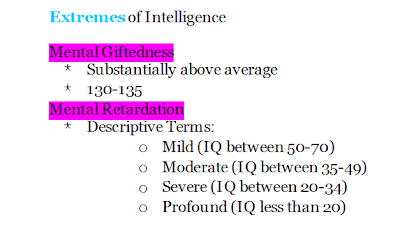

The next step was to read the chapter to review what was covered in class. I highlighted anything else that seemed important to know.
The last step was to create test questions that I thought my professor might ask on future exams. I used the same questions from Charlie Reads SmarT strategy.
For the Charlie Reads SmarT strategy, I had to do the following:
- Chunk the reading assignment
- Read with a purpose
- Summarize
- Test
For the first step, I had to determine my attention span. I started to read until I felt to lose focus. I determined that I could read 5 pages, so for every section I read 5 pages then took a break before continuing to read. I had to read 20 pages in all and there were also certain sections that I did not need to read because they were parts that my professor would not go over. This really helped me keep focus and understand the reading better.
According to my syllabus, we would spend two days going over the intelligence chapter. For this week, I only had to read half of Chapter 7. While reading, I took note of the topic and turned the headings into questions. There were already questions concerning the topics at the head of each section, so I used them because my professor would most likely use them as questions on tests. Upon reading, I wrote down the answer to each question. I also took note of key terms within each section.
After reading, I combined the summarize and test steps by creating an outline organized by section and topic with questions and key terms. Since I am a visual learner, I highlighted the answers and key terms. I wanted my outline to be visually appealing.
Here is the outline I created:

I thought that the Charlie Reads SmarT strategy was more effective for me compared to TART because it helped me clarify and review important definitions within the textbook. TART helped me get an understanding of what the reading was going to be about.
This past week, I have been using Plug-in Notes and 1 Plus 3 Notes as note-taking strategies in my PSY 205 class. I thought that by using these strategies, I'd be able to anticipate test questions and learn to better understand the topics covered in lectures within the previous class. I found to really like using Plug-in Notes in this class. 1 Plus 3 Notes was similar to Plug-in Notes, but it was not as effective in my view.
My psychology professor provides the class with outlines to each lecture and organizes them by topic. For each class, I copy and paste the outlines into the Microsoft Office OneNote program, which lets me organize my notes and audio record my professor's lecture. All I have to do during class is fill in the missing information into the outline notes.
When using Plug-in Notes, instead of plugging in organizers, I added a summary with test questions at the end of each given outlines. It was easier to do this since my professor already gave us a sum up of the lecture within the outlines. Utilizing these outlines will help me further study for upcoming exams.
Before taking notes, I got myself familiar with the Microsoft Office OneNote program. I formatted the notes my professor provided us with. During class, I would record the lecture and write down notes that were not already mentioned in the outlines. After class, I summarized key points during that lecture and anticipated test questions that could be on the next exam.
Here's a screenshot of the Plug-in Notes I took for PSY 205:
 For 1 Plus 3 Notes, I looked over my notes after class and created a chart with key terms, a graphic organizer with definitions, and test questions with answers. This was very similar to my Plug-in notes, but it let me get familiar with certain terminology.
Here are screenshots of my 1 Plus 3 Notes: 
 Plug-in Notes was very effective in that it made me more familiar with the lectures and gave me a better understanding of what could be on the next exam. I really liked using this technique and I will use it in the future for this class. This has been one of the most effective note-taking strategy for this class. 1 Plus 3 Notes was a little bit effective but not to the extent as my Plug-in Notes were.