Friday, November 18, 2011

A Day at a Time and Five-minute Escape

Hello, all! During the Thanksgiving break, I hope everybody do whatever you want and enjoy the time with your family and friends!

For this week stress management strategies, I used A Day at a Time and Five-minute Escape and I found both strategy could help me when I was stressed out before the break and I guess I will use them in the future.

For A Day at a Time, I wrote down no more than five things which drives me crazy before I go to bed every night and crossed out the things I have solved in order to reduce stress. I wrote it because I am a kinesthetic and linear learner and writing things down and deleting the finished tasks helps me to feel more accomplished and productive. As you can see, there are some items stay in my list more than two days, for example, the paper, which is a big problem for me, but finally on Wednesday night, I eliminated the stress for paper and I felt very very fantastic because of it. Here are all the lists I did for this week:


I also used five-minute escape this week, which is helpful for me to get rid of the stresses in the real life. I tried meditation this semester under the influence of a friend and she took a class on how to reduce the stress and gave me the CD they used in the class, which contains a lot of meditation music and I found it helpful when I can not focus sometimes.


Both of the strategies work for me when I feel stressed out and I will choose A day at a Time when I am overwhelmed and have a lot of things to do, because it teaches me to get more organized in my life.

Stress Diagram and 5-Minute Escape

Hi girls! Happy Thanksgiving! I am so excited for the break. I am ready to just be with my family and friends back home and sleep!

And speaking of sleep, it's something I have a hard time doing when I am STRESSED! Which is why this week's Tech assignment came at a perfect time! This week I chose to use the Stress Diagram and 5-Minute Escape strategies. Here's how they went for me!

Let's start with the Stress Diagram. I didn't find this particular strategy as helpful as I did the 5-Minute Escape, because I already had a good handle on what exactly was stressing me out. I know that the readings I have for my Intro to Theatre class give me the most grief, and I know that finances give me a little anxiety as well. However, it was beneficial to be able to see an overview of what was making me the most stressed. Here's the chart I made:
I didn't draw it by hand, shocking! I actually didn't trust myself to draw a nice circle...I have no visual art skills. So, overall, this was a good strategy, but I feel like it didn't help me as much as I anticipated it would.

Next, let's talk about the 5-Minute Escape! Now, I loved this strategy. I try to do a meditation every day, and it's great to know that it actually is proven to be beneficial and it's not just my mind playing tricks with me! When I meditate, I use the free meditations provided online by Gabrielle Bernstein, a graduate of the SU Drama department who is now a life-coach and spiritual guide. It sounds kind of fluffy and stupid, but she helps me relax so much! I definitely recommend using her free meditations. Here's the link if you want to give it a try!
http://itunes.apple.com/us/podcast/gabrielle-bernstein/id341081292

Have a great break, everyone! I look forward to seeing you all refreshed and well rested in a week!

Drive away stress by using STRESS DIAGRAM and 5-MINUTE ESCAPE

Hey, girls. Hope right now you all start enjoy your wonderful holiday with your family or your friends!

For this week, I used Stress Diagram and 5-Minute Escape in all of my courses because basically, most of my stress comes from my academic. Exams, homework, discussions are totally make me exhausted everyday. Plus I need to handle different kinds of relationship problems, homelessness or health problems.

Let me talk about Stress Diagram first. I love this strategy maybe because I am major in BS Economics, I love using data and graphs to analyze problems. And this strategy is exactly my type.

Here is my list for the origins of my stress.

As you can tell from the chart, Exams, friendship (especially the relationship between my roommate and I )and health are my three big headache problems.
I made a pie chart based on this chart. Since I am a visual learner, I use different colors, each one repressed one stress.

Now, I have a very clear idea where my stress comes from. The good news is during this week, I got a very good grade in my ECN exam and I solved my problem with my roommate under the help of my RA.So I am not that kind of under huge stress any more.

The second strategy I tried is 5-Minute Escape. Believe it or not, I used this strategy before I came here when I was in high school. But this time, I added something new in it.

I took some pictures on compass everyday, which were all view picture and nobody in pictures. Here are some of them.
These are all normal trees, buildings on campus. But I find they are actually very beautiful. I looked at them without thinking anything, just let my brain take a 5-minute break. At the same time, I take deep breath again and again, I play music, which sang by Aoi Teshima. Her voice always make me easy and quite. After 5 minutes, I feel like I am refresh again!

Hope you like my picture, and try to listen to Aoi Teshima!

Stress Diagram and 5-Minute Escape!

Hello girls!

I hope you all have a fantastic Thanksgiving Break. Go eat lots of turkey and pie and have fun spending time with family!

So for this week's tech assignment, I decided to use the
Stress Diagram and the 5-Minute Escape as stress management strategies. These two techniques can apply to all of my courses. The 5-Minute Escape is great to use whenever you are feeling stressed out about something. It helps alleviate your stress. The Stress Diagram is a good tool to use to figure out what it is that is causing your stress.

The Stress Diagram is basically a breakdown of the sources of stress that you're experiencing. I wanted to figure out what was causing my stress, which would help me determine on my own how to handle it. First, I made a list of these sources that have been lately causing me stress in order from most stressful to least stressful.

Here is my list of sources:

1. Grades
2. Spending Money
3. Routine Chores
4. Relationships
5. Health

Then, I incorporated all of these sources into a pie chart with each section representing the relative amount of stress it has on my life.

Here is my pie chart:


Since I am a visual learner, this pie chart really helped me recognize what sources were giving me the most stress. For me, grades, chores, and managing money have been the most stressful sources. Now, I understand what is causing me stress and I can find ways to lessen my stress.

For my second strategy, I used the 5-Minute Escape. This is a stress-relieving technique, which incorporates meditation and breathing. I am familiar with meditation considering the fact that I am taking a yoga course. I liked this strategy a lot because it effectively made me feel relaxed and relieved from stress in only a few minutes.

Since I don't have documentation of this technique, I'll just explain the steps of doing this strategy.

First, I made sure that I was in a quiet space. I did this alone in my dorm room in the middle of the day after class, when not many people were around to disrupt me. I closed my eyes and took a couple deep breaths. Then I rolled my shoulders backwards and forwards a couple times, massaged my temples and relaxed my jaw, moved my head in a circular motion, massaged my trapezius muscle, took a few more breaths, then opened my eyes.

This technique was very effective in that it helped clear my head of all the negative and stressful events that were occurring in my life. Since I am also a kinesthetic learner, this technique was really effective in actually relieving me of stress. I recommend using this technique before a test, after class, and any other time when you are feeling stressed.

Both of these stress management techniques are helpful in that the Stress Diagram helps you determine the causes of your stress while the 5-Minute Escape relaxes and alleviates your stress.


Thursday, November 17, 2011

Stress Diagram & 5-Minute Escape


Hello everyone! How ready are you for fall break? I am SO ready. Can't wait to relax and stop stressing. Speaking of stressing... this week was all about finding out how you stress, why you stress, and how you can preventstress from happening.

This week I used the stress diagram to figure out what areas of life are stressing me out the most. I'm a visual learner and happen to love pie charts, so this was right up my alley! My GPA is my biggest stressor; it is what is going to determine whether I can transfer into the major I want. Therefore, my GPA is always on my mind. Every single assignment that I turn in, I think... what is this going to do to my GPA? It's a daily stressor and can become quite a pain.

Next up is my job. I work at the Daily Orange as an assistant photo editor. Lately, I've been extra busy because of my job. Our head photo editor quit recently and since then it has been up to me and three other assistants to manage the photo department of the paper. Phew.. sometimes I'm working until 2am. I absolutely love my job, but with all the other work I have to do, it can really build up stress.

Lastly is my social life. Between school work and my job, I try to keep a good balance with my social life. With relationships and friends, things can sometimes get stressful. Overall, it's not too big of a stressor.


Now that I had determined what is stressing me out, it was time to find a way to relax. This is where the 5-minute escape comes in. I decided to buy a new, relaxing album that I could just sit down and listen to. It's truly a "me-time" album! It's called "The Errant Charm" by Vetiver.


Sunday, November 13, 2011

Time Wasters & Excuse Busting

Hello all, it's time to talk about procrastination. Just saying the word makes me uneasy! We all do it, and we all know how it feels to procrastinate; not good, right? Right. So, this week we're going to talk about two strategies that will help you kick this bad habit.

First, *Time Wasters* is a great way to physically lay out exactly what kind of things you are doing that is wasting your time (if you're a visual learner like I am, this is perfect). Showing exactly what you do to procrastinate an assignment or studying you have to get done actually helps you realize that it's time to start working and stop messing around. I used this strategy for my CLS, Spanish, Transmedia, and Photo classes. Here is my time waster chart:


I found this strategy effective in that it showed me that sometimes I don't even start my projects, and that can really build up and cause a lot of trouble in the future. Why add the stress when you can go on facebook after work is done?

On to my next strategy: Excuse Busting. This strategy is quite similar to the previous, except instead of showing what you do to procrastinate, this strategy shows you why you procrastinate (what are your excuses?!). Here is my excuse buster chart:


This strategy really translates what you're thinking in your head when you choose to procrastinate. For me, it made me feel quite silly! The strategy almost forces you to ask yourself, wait.. why do I actually procrastinate? Loved it.

Time Wasters and Admitting the Consequences

Hey everyone! I hope you all have had a great weekend!

This week, I decided to use
Time Wasters and Admitting the Consequences as procrastination strategies and applied them in all of my courses. Both of these strategies helped me straighten out my priorities and realize when and how I procrastinate.

For Time Wasters, I created a chart showing the things that are the
cause of my procrastination and listed the tasks that I avoid. Since I am a visual learner, this chart helped me figure out what were the sources of my distractions. These "time wasters" can be easily avoided. For example, the internet and social networking sites like Facebook are probably the number one cause for my procrastination. But by blocking and disconnecting myself from the internet, I can get my work done without distraction. I get distracted very easily and I have a short attention span so by eliminating the distraction, I can focus on my work better.

Here is my Time Wasters chart:


Now for the
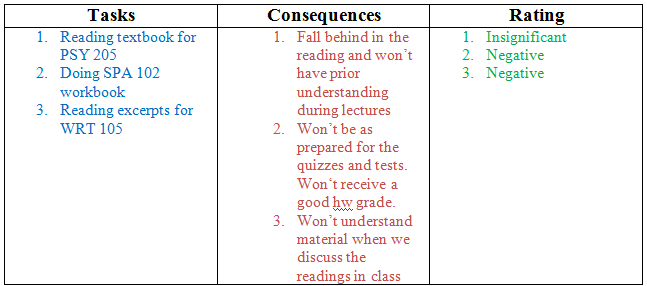
Admitting the Consequences strategy, I created another chart outlining the tasks that I avoid, the consequences for not completing those tasks, and the rating of each consequence. This helped me realize what the consequences would be if I did not complete a task. I can now plan out what I need to do in order to eliminate these distractions, therefore avoiding these consequences.

Here is my Admitting the Consequences chart:


I liked using these two procrastination strategies because they helped me
acknowledge the reasons for my procrastinating and the consequences for not doing my work. Now I can successfully do my work without procrastinating as much because I'm aware of the consequences.